
BAPL Method

The BAPL Method represents the structured “journey” from business requirements to a working software solution. Each icon/node in the diagram represents key types of business analysis information i.e. BA deliverables that can be produced by a business analysis in a software delivery project. The sequence of the BA deliverables start from the top left-hand side of the diagram to the bottom-right hand side. Not every BA deliverable will be required, it will depend on the nature and scope of the service that the BA is engaged in.
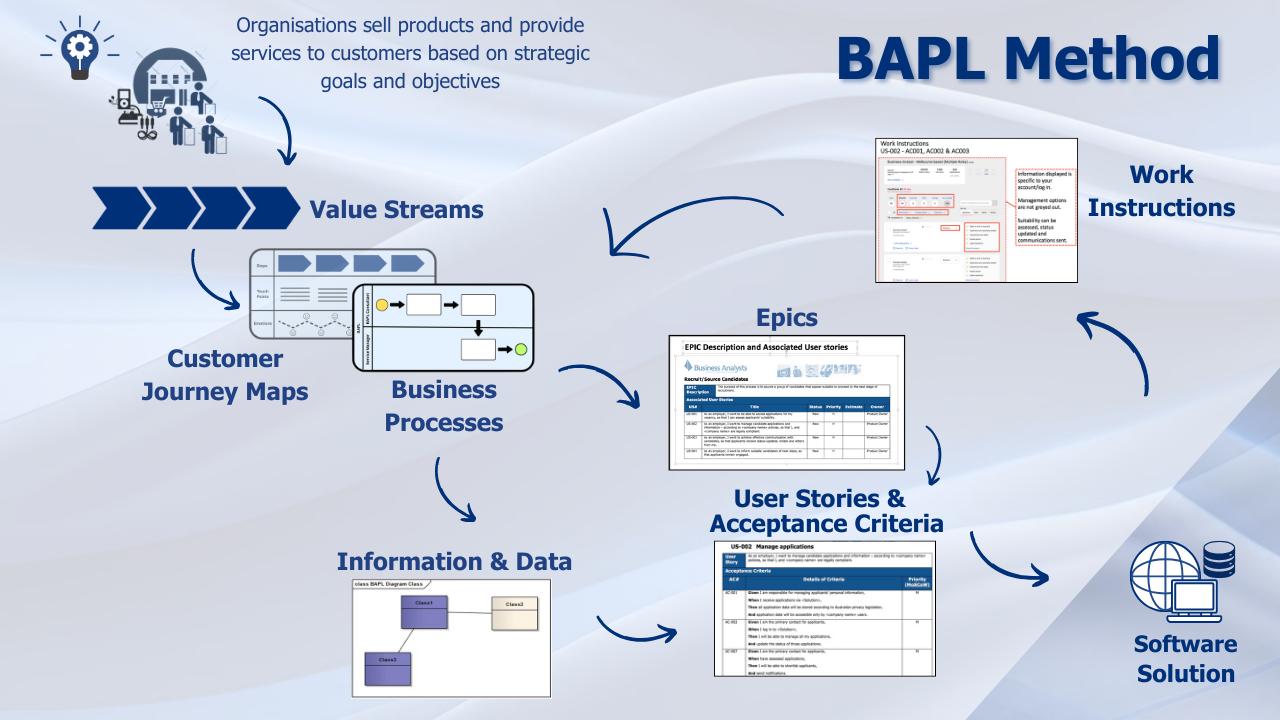
The method indicates the flow and relationships (i.e. traceability) between these key types of business analysis information.
| The diagram starts at the top left-hand corner. This icon represents the strategic planning and goal setting that is performed by all organisations. Organisations exist to provide products or services. They identify changes to these based on strategic goals and objectives. | Align to business requirements |
| Those products and services are realised and delivered through Value Streams. Value Streams are a sequence of the end to end business process steps (at the highest level) that are required to deliver value. The business requirements are used to identify and inform the selection of the value streams that are scope. | Align to stakeholder requirements |
| Value streams in turn are enabled through a sequence of business processes. There are two perspectives for representing the business processes, namely from the customer perspective i.e. as an external customer looking at the organisation to deliver a product/service (called Customer Journeys), or from inside the business looking out- to deliver products/services to the external customer (called Business Processes). The Customer Journey provides an understanding and insights into the experience of the customer when progressing through a Value Stream whereas a Business Process provides an understanding and insights into the activities and experience of the people in the organisation. |
| Where the organisation requires a software solution to support their Business Processes (and stakeholder requirements), the requirements for the software solution will follow. In agile, these are referred to as “Epics” and “User Stories & Acceptance Criteria”. Epics are decomposed to smaller user stories and user stories are further decomposed into the set of acceptance criteria for to identify the specific conditions that must be met for a user story to be considered complete. | Align to solution requirements |
| The “Information & Data” supports the Customer Journeys, Business Processes (and stakeholder requirements) and solution requirements namely Epics, User Stories and Acceptance Criteria. | Complementary models to support customer journey, business processes, stakeholder and solution requirements |
| The solution requirements i.e. Epics, User Stories and Acceptance Criteria are used as input to build the Software Solution. The Software Solution at the bottom right-hand side of the diagram represents the target solution that will realise the organisation's solution requirements. The build/development of the solution is not a business analysis deliverable (indicated by the darker triangle), however the BA provides support to the technical team doing the build. The preceding BA deliverables are used as the primary input to get the right solution in place. | Part of organisational change that once implemented realises some of the business benefits. |
| “Work Instructions” are then created as the recommended standard(s) and steps to follow when using the software solution to perform a specific activity in a business process. |
Once the change is delivered, the software solution and all the supporting artefacts become part of the “business as usual” (BAU) environment until the organisation identifies new goals and changes, whereupon the cycle starts again.
The BAPL Method is a repeatable process that identifies the key BA deliverables that are required in a sequential, logical way with traceability being supported when the flow is followed.